Sunday, February 5, 2012

Views from Withybeds

Just lovely here
Dawn Over Smithmoor Common

Withybeds Through the Buttercups

Oh Wow!

Shannon Helping to Clear the Garden

Permaculture Planning - Part 1

I am trying hard to get the basics of the planting in atWithybeds this year. I want to, as faras is practicable, run the garden as an exercise in permaculture and forestfarming. Given that this means planting quite a lot of trees and shrubs, it isa long term project, and so the sooner they get growing, the better.
We actually have a bit of a flying start with what isalready growing. A copse to the south of the cottage/garden and a high hedge tothe west mean that we are beautifully sheltered from high winds. It frequheight –good for the mistletoe and destined to be a framework for a vine) and a variety of other dessert types.
There is also a plum tree (Victoria I think) giving a fabulous crop of fruit. Having glutted on plums last year, along with the chickens who also loved them, I got almost eighty pounds of jam from the tree. It is only about 12 feet high and nothing like mature.
There is also a greengage which did not seem happy at all last year and a peach which seemed healthy enough but showed no sign of fruiting. Another peach was so obviously stunted and diseased that I removed it.
The established hedges are a mix of hawthorn and blackthorn, so the wild birds (and chickens) have had a beano with the haws whilst I took a very nice crop of sloes and produced the Christmas sloe gin.
The hedges had however been taking over the end of the garden. The garden in this area is long and thin and comes to a point. The hedges, particularly the blackthorn, had moved in, taken over and the end of the garden was lost to view when I first saw it. With saw and secateurs and the help of a friend over a few days, we battled through and discovered some forty feet of garden previously lost to the world.

The protection given by the trees and hedges really make a diffeence. It oftencomes as a surprise to venture to the outside world and find that the weatheris chilly and breezy. Meanwhile at Withybeds, breakfast was outdoors on thegarden in full sunshine and warm balmy air.

So there is a wonderful Summer microclimate. Withybeds seems to get far more than its fair shareof good weather.
The flip side to the local climate comes in Winter. LastWinter we had some of the coldest temperatures in England. Not just that, butWithybeds was substantially colder than the local area. Driving back from Uptonone night, I noted the temperature as we left the pub – minus five(Centigrade). As we drove to Withybeds – which is only a ten minute walk as thecrow flies – I watched the temperature drop, degree by degree, as I drove. Bythe time I pulled in to the cottage the outside temperature was minus eleven.
So we are in a good position for a proper “hard snap” to putplants through their dormancy. On the other hand, anything that has borderlinehardiness needs to be treated with care.
So the garden produces wonderful apples. There is wellestablished a bramley, one very old apple of doubtful variety (which I stillenjoy having there as it is an old-fashioned tree growing to its full to man. Over the last year of so, this hasbecome the area where I house the chicken coops (inside Fort Knox), the wormeryand all the paraphernalia that you know you are going to need but don’t have animmediate use for.
Other areas of the garden edges were similar, having becomeneglected and overgrown. Whilst cutting back a willow discovered another plum tree.The poor stunted little thing was valiantly trying to reach the sunshine butwas being bullied out of sight by the willow. We soon changed that and the plumis now growing very healthily and produced a very decent crop of fruit lastyear.
Willows dominate the boundaries to the East and North sidesof the garden. They were fairly heavily treated last summer, cutting downenough to bring them under control whilst I decided just what to do with them.Given that Withybeds has wood-burning stoves, they will be pollarded andtreated as firewood. In addition their early catkins should be very good forthe bees and other useful insects.
Meanwhile, the spaces between the willows will be plantedout with a variety of shrubs and small trees chosen for edibility (either forhumans or the local wildlife) and nitrogen fixing.
The boundary area up by the chickens area of the garden isgoing to be partly experimental. I am planning to plant it out with trees andshrubs which should provide free chicken feed. Hardiness may be an issue forsome as I will be trying to grow, e.g. honey locust. Time will tell if thatworks. Hardiness will certainly not be an issue for other plants. E.g. Mulberryand Siberian pea shrub. And the chucksshould have a lovely time scratching through the leaf litter fro fruits, podsand seeds – a very “chickeny” lifestyle.
I have already planted out a number of the more obviousperennials around the garden. By the fences near the copse is fairly shady fromthe trees. These have been treated as woodland edge and planted withraspberries, blackberries, loganberries and the like. If they want to “run”they can do so as any that stray too far into the lawned areas will simply getmown under control.
Other fences with more sunshine have been planted withblackcurrants, redcurrants and dessert gooseberries. Also some sharper gooseberries.The plan is to plant soft fruit in a range of sunny and shady areas to extendthe season.
Set into the lawned areas have been planted damsons, pearsand a peach. As they grow, they will be underplanted with more soft fruits andother low shrubs.

Saturday, February 4, 2012

Snow and Chickens

Poor chucks. Some never seen snow before. No idea what to make of it.... Definitely unhappy about going out in it

Winter Garden & Winter Chickens (no-where in view)


Monday, January 30, 2012

More About Chickens

The Story Continues.......

I did not intend to have a rooster. You don't need them for the girls to lay and roosters are famously noisy.

So at first I only had the girls. They were youngsters and just coming into lay when they first arrived. They were terribly cute, terribly friendly and we all got along famously.

However, after only a few weeks, as I approached them, some of the girls were crouching for me - they were treating me as though I were a rooster. That is, they were "asking" me to "tread them," I didn't like this much. It just didn't seem fair on the girls. and so I decided it was time for them to "have a man in their lives". So, Bertie Rooster became part of the team.

Again, I acquired him as a rescue. He was a youngster himself - a teenager I suppose in chicken terms. He had grown up with a couple of his brothers and had not previously had access to hens.

Having read the horror stories of what can happen when a new chicken is introduced to an established flock, I introduced Bertie under carefully controlled conditions. I placed him inside one of the mini-pens that came with the original coop so that he and the girls could see each other without actually being able to reach each other.

Instead of the open warfare I had been expecting, some of the girls seemed quite charmed by the new arrival. Of the eight girls, five ignored him, two seemed interested and one, Blackie, prostrated herself before him on the spot - she knew exactly what she required of him.

I gave it half an hour of careful observation before I decided that nothing dreadful would happen if I released Bertie, then opened the pen and waited. He pottered out, looking a bit gauche and nervous. Blackie once again spread herself before him and he completely ignored her.....When it became clear that he was quite clueless, Blackie picked herself up again with almost a cat's air of "I didn't really mean it anyway", giving herself a good shake over and starting to have a good preen (first rule of cats - when in doubt - wash!!).

It seemed, on the whole, a good start, even if Blackie didn't agree.

Two days later Bertie had discovered his libido but not his social graces. He had worked out what to do with the girls, but not how to charm the girls into seeing things his way. A chase around the garden would be followed by him catching up with the hen of his choice, grabbing her by the comb and more or less hurling her to the ground before he had his way. By any human measure it would have been called rape.... The girls clearly didn't like it much and I was beginning to think I had made a mistake.

However, over time, Bertie's manners improved. He acquired poise and confidence. He learned to call his girls over when he found a tasty tit bit. He strutted for them, inviting them to admire his magnificent plumes - and they did. After a few weeks, the girls became his devoted followers. His word was law and they followed his lead where-ever he went.

I have no real idea what, if any, breed Bertie is, except that he is terribly, terribly handsome - and knows it. His beautiful golden plumage glints in the sunshine. His lovely tail floats gracefully in the breeze and he holds himself with the dignity he knows goes with his position as head of the flock. The dignity is only a little reduced when he hears one of the girls call him from the far end of the garden and he sets of at a run to deliver her request......

Now according to the books I had read - being a beginner with chickens - many of the modern breeds of chicken have had the broodiness bred out of them. These same books assure me that the hens will happily lay their eggs in the nesting box. What a load of tripe...

Firstly, chickens lay their eggs anywhere except in the nesting boxes conveniently provided for them. It became part f my daily routine to work my way though the garden, poking under bushes, parting nettles and peering through brambles to find where the ungrateful little beasts had left their eggs.

Secondly, it is my experience that hens go broody at the drop of a hat. I didn't recognise the signs at first, but I quickly learned that a few stray fluffy feathers meant that one or other of the girls had decided to denude herself, again, in pursuit of motherhood.

The first of the girls who actually got away with it; I thought at first that I had lost her to a fox. I missed her one morning and after a search of the garden, could find no sign of her. It was pretty upsetting. I felt I had failed in my duties to the chickens. They were my charges and it is for me to keep them safe.

Three days later, I was walking up the garden, alongside the hedge, when I caught a flash of bronze in my peripheral vision. There she was - Mum was tucked into the undergrowth, and as I took a closer look, she was clearly sat on eggs - I could see two just poking out from under her, but I couldn't tell the total number of eggs.

At this point I went into a bit of a flap. I was completely unprepared for my "pregnant" chicken - no broody box, no nesting area, nothing. I couldn't leave her under the hedge - she was a sitting target i the fox turned up - as surely he would over her three weeks of sitting.

An emergency search produced an old kitchen cupboard, destined for the bonfire, which, after some alteration was reincarnated as a private nesting box. I gave it a small private run, again using one of those original runs I had rejected for being too small. Having assembled all this into a quiet corner of The Fort, I felt it was time for Mum to move house. Deciding that speed was the best way to tackle the move, I scooped her up into the cat basket I had ready and moved to pop the eggs into anotheer basket.

Eighteen eggs! She was sat on eighteen eggs! I couldn't believe it. How had she managed to hide them all that time. How could I not have seen them?

Five minutes later, Mum and eggs were esconced in their new nesting box. I felt quite smug as, after some initial protest and a lot of feather rustling, mum settled down in heer new home and resumed her brooding. I began to plan how to handle eighteen charming little cheepers in a couple of weeks.


Alas, it was not to be.

Rats arrived. First they were going after the feed. Then they were going after Mum's eggs. No matter how I tried to trap them, they failed to take bait or enter the traps I laid for them.

I first realised I had a serious problem when I noticed the smell coming from Mum's nest - rotting meat. although I was reluctant to disturb her, I lifted her off the eggs to find underneath a number of half eaten, stinking semi-developed chicks.

In the end, despite all my efforts to deal with the rats, Mum only managed to hatch one chick. He turned out healthily enough and at least she was able to have something for her efforts. But I had learned to hate rats. Although I really don't like using it, in the end I laid poison and that polished them off after about a fortnight.
Over the next couple of months, two more of the girls went broody. in each case I tried to help - moving them into safe nesting quarters. Since they were away from the grass and the earth I tried to help by occasionally misting the eggs to aid the humidity. In two cases the girls managed to hatch one egg and the third time none hatched.

Then in August we were clearing out recycling bin by the kitchen. There's a kind of mini footbridge into the kitchen with a gap underneath of about eight or ten inches. John said suddenly "There's a chicken under here".

And sure enough, there was Mum again, clearly brooding, although this time I couldn't see the eggs. Well out of reach there was no disturbing her and I had no idea how long she had been brooding - 21 days is the classic brood time for chickens, so i rather assumed that in a couple of weeks there might be a happy event. But given the recent history for hatching, I wasn't too hopeful

The following morning I opened the kitchen door to see Mum followed by one, two, three.......nine......!! balls of clockwork fluff. All apparently perfectly healthy and devotedly following Mum.

Success :-)


Thursday, January 26, 2012

New Start and Chickens

New Start on the Permaculture Blog...............and Chickens

Well, I've been living at Withybeds now for something over a year. I've not posted anything recently because of the move from Vine Tree Farm.

I had such hopes for that place, but I was constantly swimming against the tide with (some of) the neighbours. Whatever else folks think of what you are doing, when they object to trees being planted on, I can only think the world has gone entirely mad..... I had over a thousand trees planted on that hillside; a mix of native and old orchard trees. And we got complaints. People are just bloody nuts sometimes! It's not as if they didn't know that the hillside is clay and needs to be stablised.....

Never mind - it's a new start and I am carrying on regardless with my permaculture project - but now at a new site.

It's not so large this time. Withybeds has a bit under an acre of ground to work with, but it is just glorious here. And at this size, I can do most of it myself over time. I simply don't need the labour and help that I did before when I was trying to tackle 60 acres.

Anyway, where to start?

First of all - lovely neighbours. Doesn't that count for a lot? They're not too close by; at the far side of the Common, so we don't see too much of them, but when we do, there's always a smile and a bit of chat. It's just nice having them around.

And as a bonus, they keep horses, so that's making a very welcome contribution to the raised veg beds ;-)

The chickens are nicely established and doing well. It's been a bit of a learning curve as it is the first time I have kept chickens. I grew up with ducks, but chickens were a mystery to me. I had in fact intended to get ducks rather than chickens, but it was a rescue situation. The chucks had been more or less abandoned and there was a fox going in after them.

Their "keeper" wasn't even closing the pop hole at night and the fox was running wild in there - not that I begrudge him his living, but there is is field full of rabbits there for him.

Anyway, I caught all the chucks over a couple of days and brought them back to Withybeds.

It was rather awkward.This was happening December 2010 when we had the big freeze here. I had ordered a coop for the chucks, but the snow closed all the ports and the coop didn't arrive until the New Year. Meanwhile, I'd had to bring the chickens over and there was now-where properly ready for them.

So we made up temporary accomodation in the old workshop in the garden. The roof leaked and the wind was wailing through. We rigged up some perches and boxes and I lined everything out with bales of hay. Around this time the temperature dropped to around -19 (centigrade) and about two feet of snow dropped on us.

The oil for the tank wasn't delivered, even though I had ordered in in good time for December, and it cost half as much again as it had previously. Fortunately, we have wood burning stoves, so we didn't actually freeze in the cottage.

The water did freeze however. We are on a private supply here - from a borehole down into the Cotswolds rocks. It froze up and so we had Christmas dinner using melted snow-water. Having a bath was fun too. I had to get out all my jam and stock pans and heat the water over the hob. Eight pans to a bath, and all of it to be carried upstairs.

When I see one at a car boot, I'm going to pick up and old tin bath then at least if we have a big freeze again, we can bath in front of the fire.

I was really worried about the chickens in those temperatures, but what could I do apart from give them the best shelter I could manage and plenty of feed. I gave them everything I could think of to feed them calories - boiled up lentils and peas, jacket potatos, porridge - as well as standard chicken feed.

And do you know, they just completely brushed it off. You would think they would have suffered, exposed to those temperatures. But no, they were bright and chirpy and alert and barely seemed to notice the weather. It was a real lesson in just how hardy chickens are.

Since then the chucks have gone from strength to strength. They look so well and healthy. I love seeing happy animals and these just so obviously have what they need from life.

When the coop did eventually arrive I was not very happy as I realised that it was much smaller than I had envisaged. It was OK for roosting in at night, but the two tiny "runs" that came with it were not at all my idea of how much space the girls needed to roam and be happy. But I was very much on a budget. Anyway, to cut a long story short, I got hold of a job lot of security fencing (the kind they put up round building sites etc) from EBay and constructed "chicken Fort Knox" from it. Six panels fit together to make a run. The original coop I bought sits inside, along with a collection of rabbit hutches I also got secondhand from EBay. The connection to the ground is sealed with chicken wire which runs up the sides of the panels and down along the turf so that any foxes (we do have them here on the Common) cannot dig through.

So the chucks roost in the coop or hutch of their choice (or up on top of the panels in the case of some of the boys). Fort Knox is locked up at night, but the chucks are free to come in and out of their hutches/coops when it suits them. and when I get up, and there's enough daylight that the foxes should have moved along, I open up the Fort and the chucks have the run of that end of the garden.

I can't claim that it is completely safe for them, but it's as close as I can give them to safe whilst still letting them roam and scratch and generally lead a proper "chickeny" life.

I did try to let them have the run of the full garden. However, that didn't work as I couldn't keep them out of the house.

I don't have an "in principle" objection to any animal in the house with me - but I have learned through experience that you cannot house train a chicken, and it is possible to get bored with the smell of ammonia in the kitchen....

Bertie on the Birdtable - Uninivited!

And since they also made themselves at home, whether or not it was anything to with them, they had to be confined to that end of the garden.

That does also leave the small matter of the raised beds which are in that part of the garden. So far I've planted them out twice and the chucks have utterly destroyed them twice. so the next job is to construct "Vegetable Fort Knox" - more on that on another occasion
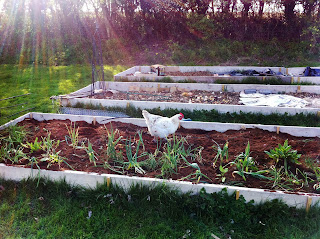
Whitey Bent on Allium Destruction

But, all that aside, they are such fun to have around. They have so much more personality than I expected, so it's definitely worth a little effort to make things work

Cleaning Up the Olive Tree

Sunday, May 10, 2009

Polytunnel

We bought a polytunnel a couple of weeks ago, and I thought "Hey, dead easy to put up.... nothing to it..."
.
Ha!
.
The first part of the job is to hammer scaffolding tubes into the ground. These are essentially the "foundations" of the polytunnel. Each length of scaffolding acts a sleeve for the main hoops of tubing which make up the "skeleton" of the tunnel.
.
Now I'm while fairly robustly built, I'm a bit puny when it comes to wielding a sledgehammer. It took me a full afternoon to get the tubes into the ground at just the right angle to take the hoops. Each hoop is made of of two parts, fitting together with a male/female joint. If the tubes are in the ground at the wrong angle, even slightly, the two halves of the hoops either don't come together at all, or they spring apart with a joyous sproinggggg!!!! noise and you have to start again.
.
Next job; get the ground sheet down. Easy enough, but I discover at this point that the supplier has been very economical with the ground pegs. The sheet is down as I place it there, but the first high wind and it'll be "I don't think we're in Kansas any more Toto....". Memo to self: purchase more grounds pegs.
.
And today's job: the doors.One either end (i.e. so that when there's a high wind, we can open both ends and avoid the Kansas scenario).
.
Of course, when fitting doors, it is a usual assumption that one is fitting the frame and door to a, more or less, "square" structure. i.e. One consisting of right angles, uprights beside which a plumb bob is parallel and horizontal lines which will not embarrass a spirit level.A word to the unwary: bashing scaffolding tubes into the ground is not an exact science. A degree or so out of true is enough to bugger things up completely. A job that I thought would take about an hour for me and another guy - he's six foot two, got a reach like an orang utan and is good with a drill and screwdriver - in fact took all afternoon to sort out just one door, not two. I'd thought we would have the plastic canopy in place by the end of the afternoon.
.
Sigh....
.
Still a task that was difficult the first time should be easy for the second. It's one of those jobs where there's a way of doing it, and number two should take about an hour. Then my multitudinous seedlings can get some shelter.
.
Watch this space......

Friday, May 8, 2009

Cider Apples

We bought a polytunnel last week. Putting it together is hard work. The job starts with hammering in three foot sections of scaffolding into the ground to take the "uprights". I'm a bit undermuscled to handle a sledgehammer, but with my mother's help got it done eventually. So I've got the supports down and the ground sheet, but Sod's Law says that as soon as I'm ready to put up the plastic sheet cover, we get a week of the windiest days for months......
Then, I met a very nice chap in the pub a few days ago. In fact it was my mum who got chatting to him, but it turned out that he is a botanist and specialises, right now anyway, in cider orchards. He's been really helpful. He's provided me with four small cider apples (variety Harry Masters) and gave me a tour of some commercial cider orchards and the associated factory.

He's also donated several strawberry plants, some shade netting for the polytunnel and a bakers bread tray (I've been trying to get hold of some). He also knows a strawberry grower, who after his strawberries have exhausted their compost, has to dispose of it. The compost is no good for strawberries, but is fine for anything else. He's also offered to try to get someone he knows to help us get the caterpillar and the earthmover working.
He's a great chap and full of useful advice. I really hope that we can keep his friendship.
On a change of subject, we have jackdaws nesting in one of the chimneys, so we won't be using the range for a few months. And yesterday i spotted a pair of goldfinches in the garden. I think they were eating dandelion seeds.